


Custom French Drain Installation Services in Central Illinois
Heavy spring rainstorms, sudden summer downpours, and melting snowpack are part of life in Central Illinois. However, when rainwater has nowhere to drain, a peaceful back yard can quickly turn into a standing swamp. Saturated soil not only ruins your grass and washes away expensive landscaping mulch, but it also creates immense water pressure against your home’s basement walls, leading to foundation cracks, damp crawlspaces, and costly water damage.
At DC Tree & Landscaping, we provide custom French drains installation and yard drainage solutions for residential and commercial properties throughout Central Illinois. Backed by over 30 years of local experience across the 309 area code, our team installs underground drainage systems designed to capture surface runoff and subterranean groundwater, safely redirecting it far away from your home’s foundation. Whether you are dealing with a spongy lawn that stays wet for days or water pooling along your driveway, we deliver long-lasting relief with our company owner directly on-site for every single installation.
How a French Drain Works to Protect Your Property
A French drain is a time-tested, gravity-fed underground channel designed to gather water that collects in low spots or underground in dense soil. Unlike surface ditches or shallow swales that leave open muddy trenches across your lawn, a French drain operates completely out of sight beneath your grass.
The mechanics of a French drain system rely on simple physics: water always flows along the path of least resistance.
When rain falls onto heavy Central Illinois clay soil, the ground quickly becomes saturated. A professionally dug French drain trench gives that trapped water an easy, porous escape route. Water filters down through a layer of clean washed stone, enters small perforations in a buried pipe at the bottom of the trench, and flows smoothly downhill through the pipe until it safely discharges at a lower grade or through a pop-up emitter near the street.
Warning Signs Your Central Illinois Lawn Needs a French Drain
Ignoring drainage problems in your yard almost always leads to bigger structural issues down the road. If you notice any of the following warning signs on your property, installing a custom French drain is one of the most effective ways to protect your investment:
- Soggy, Spongy Turf That Never Dries: If walking across your lawn two days after a rainstorm feels like stepping on a wet sponge, your soil is completely oversaturated and lacks natural sub-surface drainage.
- Standing Water Along Foundation Lines: Water pooling directly against your home’s foundation or basement windows puts continuous hydrostatic pressure against concrete walls, eventually forcing moisture through tiny pores and cracks.
- Musty Odors or Seepage in Basements and Crawlspaces: Damp spots on basement floors, efflorescence (white powdery salt deposits) on concrete block walls, or persistent musty smells indicate that groundwater is building up outside your foundation.
- Eroding Topsoil and Washed-Out Mulch Beds: Heavy surface runoff cutting muddy channels through your flower beds or washing mulch onto your driveway means surface water is moving too quickly without an underground collection point.
- Cracked or Settling Concrete Flatwork: Water pooling underneath concrete patios, walkways, or driveway edges washes out the supporting gravel base, leading to uneven, sunken, or cracked slabs.
Types of Drainage Systems We Design and Install
Every property features a unique slope, soil density, and rainwater footprint. We evaluate your yard’s specific layout to install the ideal combination of sub-surface drainage components:
1. Exterior Lawn and Swale French Drains
Designed to eliminate low-lying mud pits and standing water in the middle of a yard. We cut a trench across the lowest point of your lawn to collect both surface water and underground soil saturation, carrying it discreetly to a lower discharge point.
2. Deep Curtain (Foundation) French Drains
Installed parallel to your home, garage, or retaining wall. Deep curtain drains act as a protective subterranean shield, intercepting underground water moving toward your structure and redirecting it before it reaches your foundation walls or hardscape footings.
3. Integrated Downspout and Catch Basin Lines
Roof downspouts dump hundreds of gallons of water directly at the corners of your home during a single storm. We pipe gutter downspouts directly into smooth-bore solid discharge lines, pairing them with surface catch basins to keep heavy roof runoff away from your foundation.
Anatomy of a Heavy-Duty French Drain System
A cheap drainage job that skips filter fabrics or uses thin, corrugated plastic pipe will clog with dirt and roots within two or three seasons. We build every French drain using commercial-grade, heavy-duty materials designed to keep water flowing freely for decades.
Key components of our long-lasting installations include:
- Non-Woven Geotextile Filter Fabric: We line the entire raw dirt trench with heavy-duty filter fabric. This fabric acts as a permanent barrier that allows water through while keeping fine Central Illinois clay silt from clogging the gravel core.
- 3/4-Inch Clear Angular Stone (CA-7): We surround the drain pipe with clean, washed angular stone. Unlike round river rock or dirt, clear angular stone leaves open pockets for high-volume water flow.
- Heavy-Duty Perforated Pipe: We use rigid or heavy-duty piping installed with perforations facing downward. As groundwater rises into the aggregate, it enters the bottom holes of the pipe and drains away rapidly.
- Pop-Up Discharge Emitters: At the end of the line, water exits through a green pop-up emitter installed flush with your lawn near the street, curb, or storm ditch. The emitter pops up under water pressure to release flow, then seals flat when dry to keep lawnmowers safe and leaves out.
The DC Tree & Landscaping Difference: Owner-Operated Quality
Installing underground drainage requires accurate pitch calculations, heavy digging, and meticulous material assembly. When property owners hire inexperienced sub-contractors, they often end up with back-pitched pipes that trap standing water underground or messy trenches that ruin their lawn’s appearance.
With over 30 years of hands-on field experience in Central Illinois, our owner-operator personally checks laser pitch readings, verifies fabric encapsulation, and manages the site workflow. We use turf-protection mats to keep heavy machinery from tearing up your grass, and we clean down your property completely before leaving.
Fix Your Yard Drainage Problems Today
Do not let another severe Midwest rainstorm flood your yard or threaten your home’s foundation. Protect your lawn, restore your peace of mind, and enjoy a dry, usable outdoor space with custom drainage solutions built by local hardscaping experts.
Call DC Tree & Landscaping today at 309-835-3846 to schedule your free, on-site French drain consultation.
Frequently Asked Questions About French Drains
How deep does a French drain need to be buried?
For standard yard surface drainage and swales, a French drain trench is typically dug 12 to 18 inches deep and 10 to 12 inches wide. For foundation protection (curtain drains), the trench may be dug 24 to 36 inches deep (or down to the footing level) to intercept groundwater before it reaches basement walls.
Will a French drain eliminate standing water in my basement?
An exterior French drain stops groundwater from building up outside your foundation walls, which eliminates hydrostatic pressure—the leading cause of basement wall seepage. While interior sump pumps handle water that has already entered, an exterior French drain prevents water from reaching your basement walls in the first place.
How much does French drain installation cost in Central Illinois?
French drain costs vary based on linear footage, trench depth, accessibility, soil conditions, and the specific discharge outlets required (such as pop-up emitters or catch basins). Because every yard layout is unique, we provide free, on-site consultations to give you an accurate, transparent quote with zero hidden fees.
Should the holes in a French drain pipe face up or down?
The perforations in a French drain pipe should always face downward. As groundwater saturates the dirt, it rises from the bottom of the gravel trench upward into the pipe holes. If holes face upward, the water level must rise to fill the entire pipe before it starts draining, which leaves standing water sitting in the bottom of your trench.
Our 4-Step French Drain Installation Process
We take a detailed approach to every drainage project, ensuring accurate pitch, clean work, and minimal disruption to your existing turf.
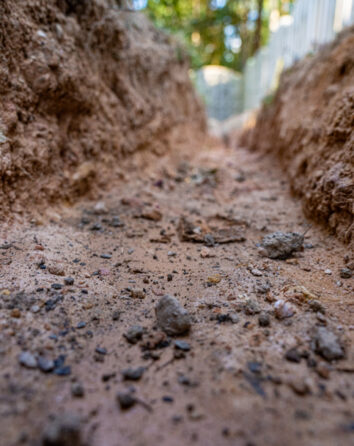
Utility Locates and Laser Elevation Mapping
Safety and accurate slope calculations are critical. We contact JULIE (811) to mark all underground gas, electric, water, and fiber-optic cables before digging. We then use commercial laser levels to map out the exact elevation drop across your yard, guaranteeing a consistent minimum 1% slope (1 foot drop for every 100 feet of pipe run) so water never stalls in the line.
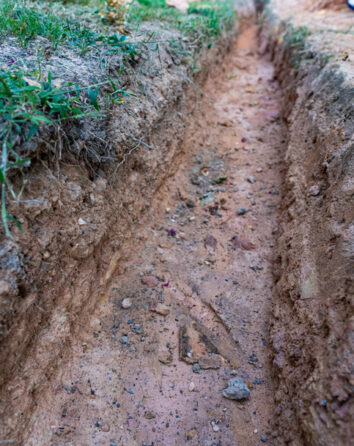
Trench Excavation and Geotextile Fabric Lining
Using specialized trenching equipment and hand tools, we excavate a trench along the mapped drainage line. We clean out loose dirt, verify the smooth bottom slope, and line the entire trench with non-woven geotextile filter fabric, leaving extra fabric extending up the sides to wrap over the top later.

Gravel Bedding, Pipe Placement, and Stone Backfill
We pour an initial bed of clear washed stone along the trench bottom, lay down the perforated pipe with the drainage holes facing downward, and connect all necessary fittings and catch basins. We then backfill the trench with clear aggregate stone to within a few inches of the top lawn line.

Fabric Wrapping, Topsoil Backfill, and Turf Clean-Up
We fold the extended filter fabric over the top of the stone layer, creating a completely encapsulated “envelope” of aggregate and pipe. We top off the trench with fresh, screened topsoil, tamp it gently, and apply grass seed or re-lay saved sod so your lawn restores quickly and cleanly.